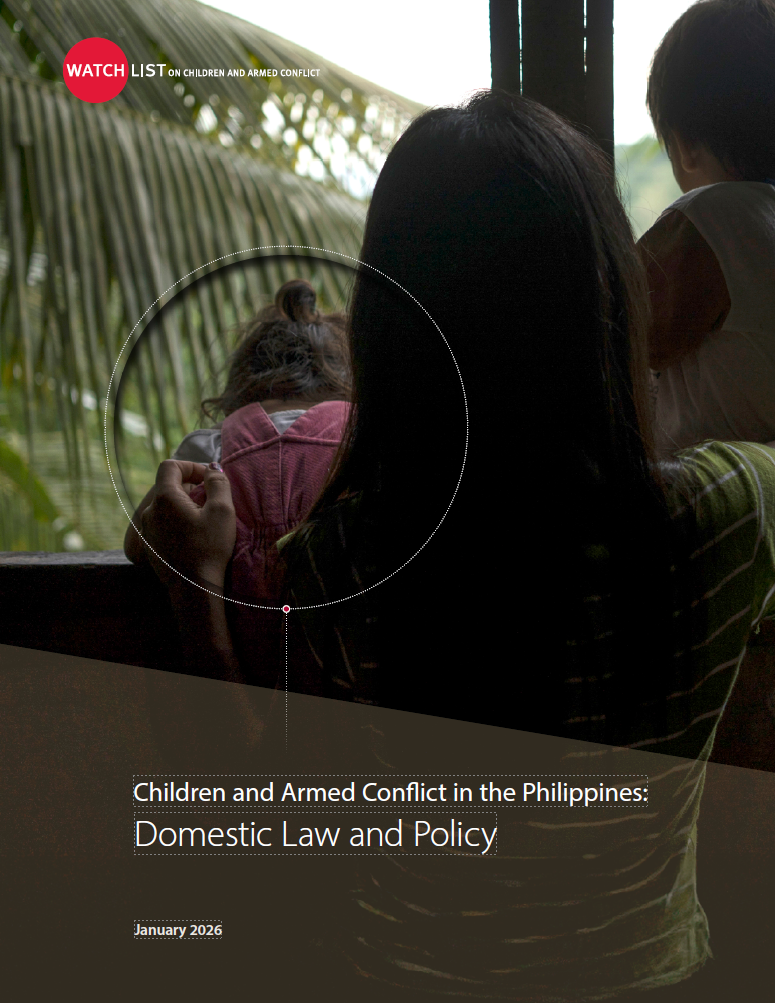
January 2026 – Watchlist is pleased to announce the publication of its new report Children and Armed Conflict in the Philippines: Domestic Law and Policy.
As part of Watchlist’s “Bringing Multilateralism Back Home” project, this report examines domestic laws and policies in the Philippines relevant to protecting children during armed conflict. This analysis builds on an earlier Watchlist report that examined trends across 25 situations of concern on the United Nations’ (UN) children and armed conflict (CAAC) agenda, as well as Watchlist’s follow-up report presenting case studies of the Democratic Republic of the Congo, Colombia, and Ukraine.
The Philippines has been a situation of concern since the Secretary-General published the first list, in 2002, of parties to armed conflict responsible for perpetrating grave violations against children during armed conflict. Between 2002 and 2025 in the Philippines, the UN documented harms against children that included all of the six grave violations— those being recruitment and use of children, killing and maiming of children, rape and other forms of sexual violence against children, attacks on schools and/or hospitals, abduction of children, and denial of humanitarian access for children—as well as incidents of detention of children and the military use of schools and/or hospitals. In his 2025 annual report on CAAC, the Secretary-General announced that the Philippines will not be included in his future annual reports on CAAC, unless the conflict dynamics in the country shift, due to the comparatively low level of grave violations in the country and in light of preventive measures adopted by the Government of the Philippines. This decision followed a June 2025 agreement between the UN and the Philippine government on a road map for child protection.
In the context of the removal of the Philippines as a situation of concern from the Secretary-General’s future annual reports on CAAC, this report examines over two decades of Philippine government efforts to develop relevant law and policy. Notably, these efforts include the adoption in 2019 of “Republic Act No. 11188: An Act Providing for the Special
Protection of Children in Situations of Armed Conflict and Providing Penalties for Violations Thereof” (hereafter the CSAC Law). As this report will examine in depth, this law—among many others adopted in the country comprehensively addresses harms that children in armed conflict face. Nevertheless, as this report will also discuss, key challenges persist for protecting children from harms related to armed conflict in the Philippines.
This report does not address policies and rules adopted by non-state armed groups (NSAGs) operating in the Philippines. New People’s Army (NPA), Moro Islamic Liberation Front (MILF), Moro National Liberation Front (MNLF), Abu Sayyaf Group (ASG), and Bangsamoro Islamic Freedom Fighters (BIFF) have all been previously listed by the Secretary-General as responsible for recruitment and use of children during armed conflict. Although examining the conduct of NSAGs is necessary to understand the full picture of protecting children impacted by armed conflict, this report focuses specifically on presenting a case study of governmental legal and policy efforts.
This report is based on an analysis of legal and policy documents in the Philippines, a desk review of relevant literature, and research interviews and consultations conducted with practitioners that have experience and/or expertise relevant to the CAAC agenda in the Philippines. Part I offers a brief historical overview of the implementation of the UN’s CAAC agenda in the Philippines. Part II discusses key domestic laws and policies in the Philippines relevant to protecting children during armed conflict. Part III presents persistent challenges. Part IV offers recommendations for further action by domestic and international stakeholders.
Read the full report here.